
Do Wisdom Teeth Cause Crowding?
We hear this one all the time: “My bottom teeth are getting crowded. Is it my wisdom teeth?”
Honestly, it’s a fair guess. Wisdom teeth show up in the back of the mouth, there never seems to be enough room for them, and right around the same time your lower front teeth start looking a little less cooperative. It’s easy to picture those back teeth shoving everything forward like someone squeezing into the last seat on a crowded bus.
It’s a great story. It’s just not what the research shows.
How wisdom teeth got blamed
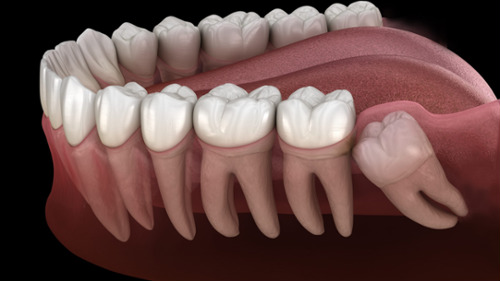
Wisdom teeth (or third molars, if you want to sound fancy at dinner parties) are the last teeth to come in, usually in the late teens or early twenties. That also happens to be when a lot of people first notice their lower front teeth shifting.
So the theory went like this: the wisdom tooth pushes on the tooth in front of it, that tooth pushes on the next one, and the pressure works its way forward until the front teeth get crowded. A slow-motion game of dental dominoes.
A few early studies seemed to back this up, and the idea stuck around for decades. Then researchers started looking more closely.
What the research actually found
One of the best studies came out of the University of Washington. Researchers followed orthodontic patients for at least ten years after treatment and sorted them into four groups: wisdom teeth impacted, wisdom teeth fully erupted, wisdom teeth removed, and wisdom teeth that never developed at all.
The amount of lower front crowding was about the same in every group.[4]
That last group is the real giveaway. People who were born without wisdom teeth still got crowding. Hard to blame a tooth that isn’t there.
Researchers in the UK went a step further and ran a randomized controlled trial, which is about as good as evidence gets. They randomly assigned post-braces patients to either have their developing wisdom teeth removed or keep them, then checked back about five years later. The removal group did have slightly less crowding on average, but we’re talking roughly a millimeter. The authors didn’t think that was enough to justify surgery for that reason alone.[5]
Big-picture reviews that pull together all the available studies have landed in the same place. A 2014 review found no clear evidence that wisdom teeth are a main cause of lower front crowding.[1] A 2023 review that looked specifically at crowding after orthodontic treatment didn’t find a clear link either, and concluded there’s no good case for removing wisdom teeth just to protect your braces results.[2]
So what’s really going on?
The short version: mouths change. All of them, all the time, for your whole life.
That same Washington research group found that lower front crowding often kept increasing 10 to 20 years after treatment, and there was no reliable way to predict who it would happen to.[6] And it’s not just a braces thing. People who never had orthodontic treatment see the same changes.
A handful of things contribute. The lower jaw can keep growing a bit into your late teens and twenties, which changes how the front teeth sit. Your lips, cheeks, and tongue are pressing on your teeth constantly, even when you don’t notice. Your bite shifts over time, and the gums and bone around your teeth change as you age. No single factor is the villain. It’s more of a group project.
Wisdom teeth just have terrible timing. They tend to show up at the scene right when all of this is happening, so they get blamed.
“But I had braces and now they’re moving!”
We get it, and it’s frustrating. You put in the time, you wore the rubber bands (most of the time), and your teeth looked great. Now they’re drifting.
The most likely culprit isn’t your wisdom teeth. It’s the natural tendency of teeth to move over time, plus a retainer that may have started spending more time in a drawer than in your mouth. Teeth don’t get the memo that treatment is over.
That’s why orthodontists talk about retainers so much. Whether it’s a removable retainer you wear at night or a thin wire bonded behind your front teeth, long-term retention is the most reliable way to keep teeth where we put them.[7]
Yes, we know we bring this up a lot. No, we’re not going to stop.
Should you get your wisdom teeth out?
Sometimes, absolutely. There are plenty of good reasons to remove wisdom teeth, and your dentist or oral surgeon is the right person to sort that out. Wisdom teeth that are impacted, only partly erupted, hard to keep clean, causing infections or gum problems, getting cavities, or damaging the molars next to them often need to come out. Those are decisions based on the health of the wisdom teeth and their neighbors.
What the evidence doesn’t really support is pulling healthy wisdom teeth just to keep your front teeth straight. A Cochrane review, which is one of the most respected types of evidence summaries in healthcare, looked at removing healthy, symptom-free impacted wisdom teeth. It didn’t find enough evidence to recommend doing it routinely, and it found no good evidence that removal prevents front teeth from crowding later on.[3]
So if your dentist or oral surgeon recommends taking them out, there’s likely a solid reason, and it’s always fair to ask what it is. Preventing crowding just usually isn’t it.
Okay, but could they play a small role?
Maybe! We’re not going to pretend wisdom teeth have zero effect on every person on the planet. The research isn’t perfect, and that randomized trial did show a small difference. It’s reasonable to think an erupting wisdom tooth might nudge things a little in some people, as one small piece of a much bigger puzzle.
What we can say is that they aren’t the simple, open-and-shut cause people once thought. Crowding happens in people with wisdom teeth, in people who never had them, and in people who had them removed years ago.
The bottom line
Wisdom teeth have a reputation for wrecking orthodontic results, and for the most part, they don’t deserve it. Lower front teeth tend to get a little more crowded with age for a bunch of reasons, and that’s a normal part of how mouths change over time.
Let your dentist or oral surgeon evaluate your wisdom teeth on their own merits. And if you want to keep your smile straight after braces, you already know what we’re going to say.
Wear your retainers.
(Sorry. We had to.)
References
- Stanaitytė R, Trakinienė G, Gervickas A. Do wisdom teeth induce lower anterior teeth crowding? A systematic literature review. Stomatologija. 2014;16(1):15-18.
- Genest-Beucher S, Graillon N, Bruneau S, Benzaquen M, Guyot L. The effect of third molars on mandibular anterior crowding relapse: a systematic review. Dentistry Journal. 2023;11(5):131.
- Ghaeminia H, Nienhuijs MEL, Toedtling V, et al. Surgical removal versus retention for the management of asymptomatic disease-free impacted wisdom teeth. Cochrane Database of Systematic Reviews. 2020.
- Ades AG, Joondeph DR, Little RM, Chapko MK. A long-term study of the relationship of third molars to changes in the mandibular dental arch. American Journal of Orthodontics and Dentofacial Orthopedics. 1990;97(4):323-335.
- Harradine NW, Pearson MH, Toth B. The effect of extraction of third molars on late lower incisor crowding: a randomized controlled trial. British Journal of Orthodontics. 1998;25(2):117-122.
- Little RM, Riedel RA, Årtun J. An evaluation of changes in mandibular anterior alignment from 10 to 20 years postretention. American Journal of Orthodontics and Dentofacial Orthopedics. 1988;93(5):423-428.
- Littlewood SJ, Millett DT, Doubleday B, Bearn DR, Worthington HV. Retention procedures for stabilising tooth position after treatment with orthodontic braces. Cochrane Database of Systematic Reviews. 2016.