
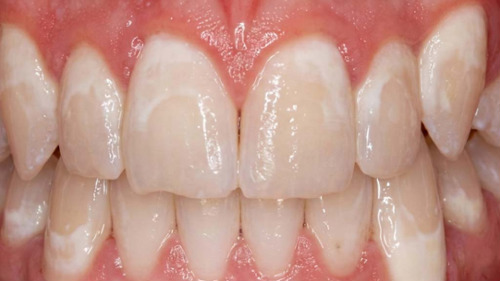
The big day finally arrives.
The braces come off. Everyone leans in for a look at the new smile.
And then someone asks:
“Wait… what are those white squares?”
If you have ever seen a smile with faint white outlines exactly where the brackets used to be, you have seen white spot lesions. And we want to talk about them now, while your teeth are still in braces and we can do something about it.
First: What Is a White Spot Lesion?
A white spot lesion is an area where the enamel has started to lose minerals.
In other words, it is the very earliest stage of a cavity.
The enamel has not broken down into a hole yet, but the surface has been weakened enough that it reflects light differently. That is why it looks chalky, dull, or bright white compared with the healthy enamel around it. The cause is the same one behind every cavity: plaque bacteria feed on sugars and produce acid, and that acid pulls minerals out of the tooth.
Why Do Braces Make This More Likely?
Braces don’t cause white spots.
But they do give plaque a lot of new places to hide.
Brackets, wires, and elastic ties create little ledges and corners right next to the gumline. Food and plaque love those spots, and they are harder to reach with a toothbrush.
This is not a rare problem. A classic study found that roughly half of patients treated with fixed braces developed at least one white spot lesion, compared with a much smaller share of untreated patients.[1] More recent research on comprehensive orthodontic patients has reported similar findings.[2]
The good news?
White spots are almost entirely preventable.
Where Do They Usually Show Up?
Most often, on the front surfaces of the teeth, between the bracket and the gums.
That little strip of enamel is easy to miss when brushing quickly, and it happens to be right in the middle of your smile.
The upper front teeth and canines are common trouble spots. Basically, the teeth everyone sees first.
So How Do We Prevent Them?
This part is not complicated. It just takes consistency.
Brush Around the Brackets, Not Just Over Them
Brushing in braces takes a little more time and a little more attention.
Angle the brush toward the gums to clean above the brackets, then angle it toward the biting edges to clean below them. Spend a few seconds on each tooth.
An electric toothbrush or a small interdental brush can make this easier, but the technique matters more than the gadget.
Use Fluoride
Fluoride helps enamel resist acid and can help rebuild minerals in early weak spots.
A Cochrane review of fluoride use during fixed braces found evidence supporting fluoride, including high fluoride toothpaste and fluoride varnish, for reducing demineralized lesions in orthodontic patients, while noting that more high quality research would be helpful.[3]
At minimum, that means brushing twice a day with fluoride toothpaste. Depending on your risk, your dentist or orthodontist may recommend a prescription strength toothpaste, fluoride rinse, or professional fluoride varnish.
Watch the Sugar and the Sipping
It is not only how much sugar you have. It is how often.
Sipping a sweet coffee drink, sports drink, or soda slowly over a couple of hours gives the bacteria in your mouth a long, continuous snack. And every snack means more acid.
If you are going to have it, have it with a meal, then rinse with water or brush.
Water between meals is your teeth’s best friend.
Keep Seeing Your Dentist
Yes, we see you often during treatment.
No, that does not replace your regular dental cleanings and exams. Your dentist and hygienist can clean areas that are tough to reach at home, apply fluoride, and catch early changes before they become a bigger problem.
What If We Notice One During Treatment?
We will tell you.
And we will probably show you exactly where it is.
This isn’t about getting anyone in trouble. It is about catching the problem early, while the lesion is still at a stage where better brushing and fluoride can help stop it from progressing.
If hygiene is a consistent struggle, we may have a bigger conversation about it. In some situations, protecting the health of the teeth can matter more than finishing every planned tooth movement.
A straight smile with damaged enamel is not the result anyone wants.
What Happens After the Braces Come Off?
Once the brackets are removed and the teeth are easier to clean, some white spots can improve over time as saliva and fluoride help the enamel remineralize.
But not every spot disappears completely.
For spots that remain, your dentist may discuss options that can improve their appearance, ranging from conservative treatments that help blend the spot with the surrounding enamel to restorative options for more significant lesions.
Those options are helpful.
But prevention is still far easier than repair.
What About Clear Aligners?
Because aligners come out to eat and brush, many patients find it easier to keep their teeth clean.
But aligners are not a free pass. If you put aligners back in over teeth that still have food or sugary drinks on them, you are essentially holding that sugar against your enamel for hours.
The rule is simple:
Brush, or at least rinse well, before the aligners go back in.
The Mischler Orthodontics Approach
At Mischler Orthodontics, we care about how your teeth line up.
We care just as much about how healthy they are when we’re done.
That’s why we’ll coach brushing technique, keep an eye on problem areas, and work alongside your general dentist throughout treatment.
The goal isn’t just straight teeth on the day your braces come off. It’s healthy, strong teeth that look great for decades.
And if you are wondering whether that strip of enamel above your bracket really needs attention tonight?
It does.
References
1. Gorelick L, Geiger AM, Gwinnett AJ. Incidence of white spot formation after bonding and banding. American Journal of Orthodontics. 1982;81(2):93 to 98.
2. Richter AE, Arruda AO, Peters MC, Sohn W. Incidence of caries lesions among patients treated with comprehensive orthodontics. American Journal of Orthodontics and Dentofacial Orthopedics. 2011;139(5):657 to 664.
3. Benson PE, Parkin N, Dyer F, Millett DT, Germain P. Fluorides for preventing early tooth decay (demineralised white lesions) during fixed brace treatment. Cochrane Database of Systematic Reviews. 2019.