
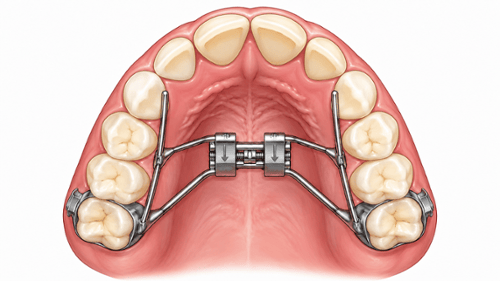
If your child has been told they need an expander, you may have had a very reasonable first thought:
“Their teeth don’t look that crooked… so why are we making their mouth wider?”
Great question.
Orthodontic expansion makes a lot more sense once you understand what we are actually trying to accomplish. And spoiler alert: we are not expanding every patient, and we are not simply trying to make room for teeth.
Sometimes the issue isn't the teeth at all. It’s the foundation they are sitting on.
So, let’s talk about why we expand, when we expand, and just as importantly, when we don’t.
First: What Are We Actually Expanding?
Most commonly, expansion means increasing the width of the upper dental arch and/or upper jaw, called the maxilla.
Normally, the upper teeth should sit slightly outside of the lower teeth. Think of a lid fitting properly over a box. When the upper jaw is too narrow relative to the lower jaw, the teeth may not fit together properly. We call this a transverse discrepancy.
We may see a posterior crossbite, a narrow upper arch, crowding, inadequate space for developing permanent teeth, or even a functional shift where the lower jaw moves to one side when biting.
The American Association of Orthodontists recommends that children have their first orthodontic evaluation by age 7. This does not mean every 7 year old needs treatment. It gives us an opportunity to identify developing problems at an age when growth may help us correct them.[1]
And sometimes the correct recommendation at age 7 is:
“Everything looks great. See you in a year.”
We like those appointments too.
Why Does Age Matter?
This is where orthodontics gets interesting.
The right and left sides of the upper jaw meet along an area called the midpalatal suture.
In a growing child, this allows us to produce an orthopedic change in the width of the maxilla. In simple terms, we can influence the width of the developing foundation rather than relying entirely on moving the teeth.
This concept is well established in orthodontics and is discussed extensively by Proffit and colleagues in Contemporary Orthodontics.[2]
As skeletal maturity increases, resistance from the midpalatal and surrounding sutures generally increases as well. So the same appliance does not necessarily produce the same response in an 8 year old, a teenager, and an adult.
Research supports this. Rapid maxillary expansion produces both skeletal and dental changes in growing patients, with younger and less skeletally mature patients generally demonstrating a greater orthopedic component.[3][4]
When we have a true skeletal width problem, there can be an advantage to addressing it while growth is still on our side.
Phase 1 Expansion: Why Treat Something So Early?
Phase 1 treatment typically occurs during the mixed dentition, when children have a combination of baby teeth and permanent teeth.
One misconception about Phase 1 treatment is that we are trying to give an 8 year old a perfect Hollywood smile.
We're not.
The goal is usually much more specific: identify a developing problem that is better addressed now than later, correct what is necessary, and allow normal growth and eruption to continue.
Expansion during Phase 1 may be appropriate for a true transverse maxillary deficiency, posterior crossbite, functional shift of the lower jaw, significant constriction affecting eruption, or certain situations where additional room for developing permanent teeth is needed.
The American Academy of Pediatric Dentistry notes the importance of evaluating crossbites during the developing dentition and recommends early correction of crossbites associated with functional shifts.[5]
The key is this:
Early treatment should have a clear indication and a clear objective.
Age alone isn't a reason to begin Phase 1 treatment. We consider whether intervening now gives us a meaningful advantage over simply monitoring growth and treating later.
Sometimes it does.
Sometimes it doesn't.
What About Crowding?
This deserves some nuance.
Expansion can increase available arch perimeter and create additional room for developing teeth.[2]
But that does not mean:
Crowding = expander.
Orthodontics would be much easier if every diagnosis worked like a flowchart. Unfortunately, humans insisted on growing unique faces.
Crowding can result from tooth size, jaw size, tooth position, eruption patterns, skeletal relationships, or some combination of these.
We evaluate the entire picture, including facial proportions, bite, arch width, tooth position, supporting bone, eruption pattern, skeletal relationships, and remaining growth.
The goal isn't simply to fit all the teeth somewhere.
The goal is to place them in positions that make biological and orthodontic sense.
What About Expansion During the Teenage Years?
This is where the answer becomes:
It depends.
There isn't a magical age when conventional expansion suddenly stops working. Skeletal maturity varies considerably from person to person.
A younger adolescent with substantial growth remaining may respond very well to a conventional palatal expander. As skeletal maturity increases, however, expansion encounters greater skeletal resistance and may produce proportionally more movement of the teeth and supporting structures rather than true skeletal expansion.[3]
That's why two teenagers of the same age may receive completely different recommendations.
Age matters, but skeletal maturity, anatomy, and the underlying problem matter more.
Sometimes traditional expansion makes perfect sense. Sometimes a different approach makes more sense. And sometimes no expansion at all is the best option.
Okay… What About Adults?
Adults can absolutely undergo orthodontic expansion, but we have to distinguish between two things:
- Dental expansion: moving or uprighting teeth within their supporting bone.
- Skeletal expansion: actually increasing the transverse width of the upper jaw.
For modest movements, adults may be able to achieve appropriate dental expansion with braces or aligners.
For an adult with a significant skeletal transverse deficiency, simply moving the teeth outward may not correct the underlying problem.
That's where options such as miniscrew assisted rapid palatal expansion, or MARPE, and in certain cases surgically assisted expansion, may enter the conversation.
Research suggests that MARPE can produce skeletal expansion in appropriately selected late adolescents and adults, although the amount of skeletal versus dental change varies and the evidence continues to evolve.[6]
So yes, adults can be expanded. But adult expansion is not biologically identical to expansion in a growing child.
But I Heard Expansion Helps the Airway…
Ah yes.
Welcome to one of orthodontics' favorite internet rabbit holes.
The maxilla forms part of the floor of the nasal cavity, so it is reasonable that changing maxillary width may also change dimensions of the nasal cavity. Studies have demonstrated increases in nasal dimensions following rapid maxillary expansion, and some studies report improvements in certain measures related to nasal breathing.[7]
But the science is more nuanced when we ask whether expansion produces meaningful, lasting improvements in breathing or sleep.
That doesn't mean we ignore the airway. Quite the opposite. We may consider breathing patterns, sleep concerns, tonsils and adenoids, nasal obstruction, allergies, and craniofacial development as part of the overall picture.
In the right patient, expansion may be one component of a broader treatment approach. In another patient, it may have little or no role at all.
The science continues to evolve, so we look at this case by case.
So… Who Actually Needs an Expander?
There isn't one measurement, photograph, or TikTok test that determines whether someone needs expansion.
We look at the relationship between the upper jaw, lower jaw, teeth, supporting bone, bite, facial structure, growth pattern, and skeletal maturity.
Expansion may make sense for a true transverse deficiency, posterior crossbite, functional shift, inadequate transverse development affecting eruption, certain crowding situations, or dental compensations masking an underlying skeletal discrepancy.
But an expander should solve a diagnosed problem.
It isn't something every child needs.
The Mischler Orthodontics Approach
At Mischler Orthodontics, expansion isn't an automatic part of treatment, and neither is avoiding it.
We look at the patient in front of us and determine whether expansion offers a meaningful benefit and, if so, what type makes sense and when it should happen.
For one child, that may mean an expander during Phase 1. For another, it may mean monitoring growth and treating later. For a teenager, the decision may depend heavily on skeletal maturity. And for an adult with a true skeletal discrepancy, we may discuss options such as MARPE.
Orthodontics gives us a lot of tools. The important part isn't using a particular one. It's understanding when, why, and for whom we should use it.
And sometimes the best treatment really is:
“Let's keep an eye on it.”
References
1. American Association of Orthodontists. Guidance regarding the age 7 orthodontic evaluation and developing orthodontic problems.
2. Proffit WR, Fields HW, Larson B, Sarver DM. Contemporary Orthodontics. 6th ed. Elsevier; 2019.
3. Seif Eldin NF, Elkordy SA, Fayed MS, Elbeialy AR, Eid FH. Transverse skeletal effects of rapid maxillary expansion in pre and postpubertal subjects: a systematic review. Open Access Maced J Med Sci. 2019;7(3):467 to 477.
4. Lagravère MO, Major PW, Flores Mir C. Long term skeletal changes with rapid maxillary expansion: a systematic review. Angle Orthod. 2005;75(6):1046 to 1052.
5. American Academy of Pediatric Dentistry. Management of the Developing Dentition and Occlusion in Pediatric Dentistry. The Reference Manual of Pediatric Dentistry.
6. Kapetanović A, Theodorou CI, Bergé SJ, Schols JGJH, Xi T. Efficacy of miniscrew assisted rapid palatal expansion in late adolescents and adults: a systematic review and meta analysis. European Journal of Orthodontics. 2021.
7. Sakai RHUS, de Assumpção MS, Ribeiro JD, Sakano E. Impact of rapid maxillary expansion on mouth breathing children and adolescents: a systematic review. J Clin Exp Dent. 2021;13(12):e1258 to e1270.